

Toshima: A Drop of Camellia Oil Nurtured by Nature
Admiring camellia blossoms and incorporating camellia oil into daily life has been intertwined with the Japanese aesthetic sense since ancient times.
Toshima Village, Tokyo.
Here, where camellia forests cover 80% of the island, camellias are still cultivated by hand and slowly transformed into oil.
Obi uses organic camellia oil from Toshima in all its products.
We visited the natural environment and production site behind this oil.
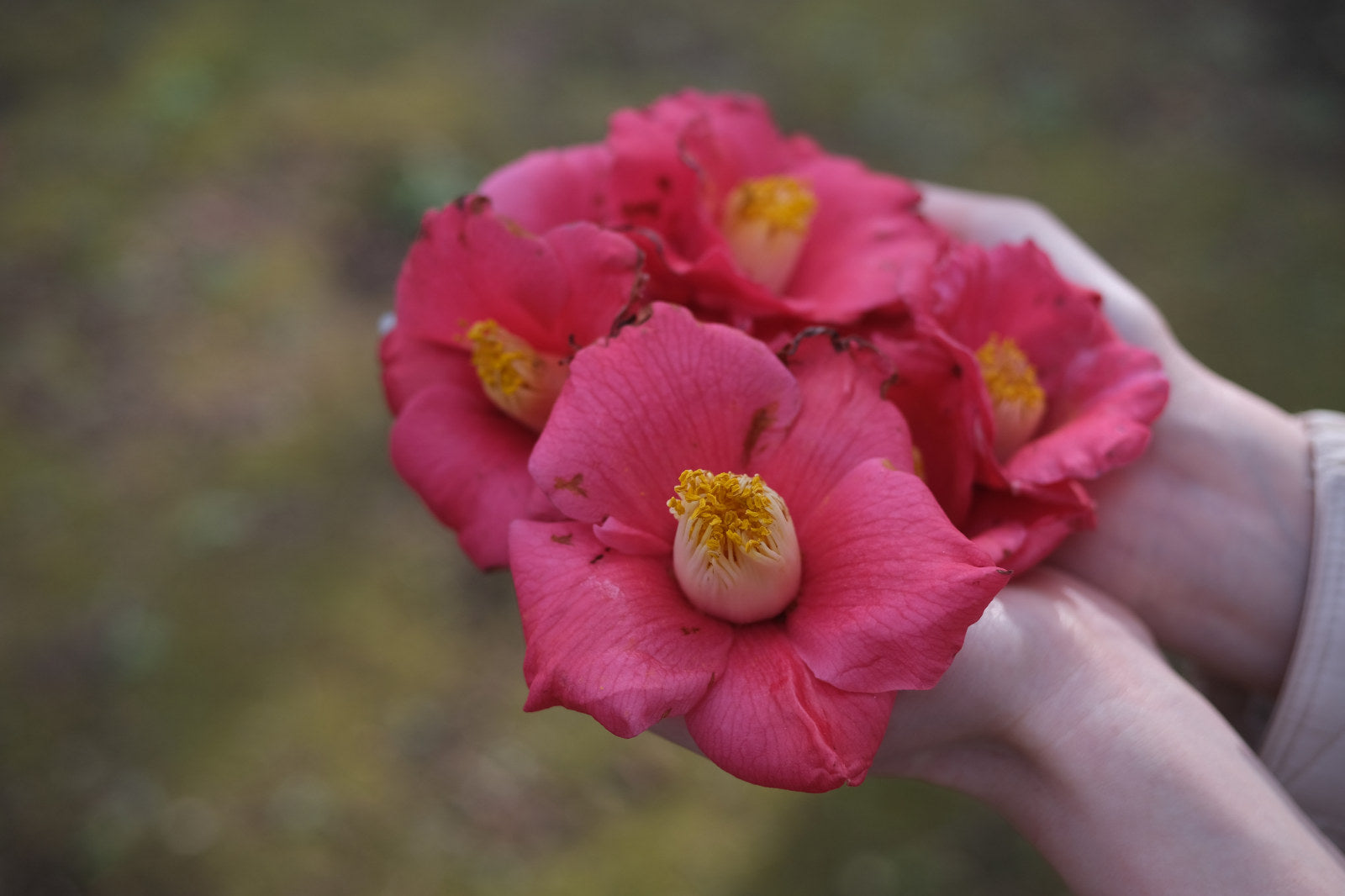
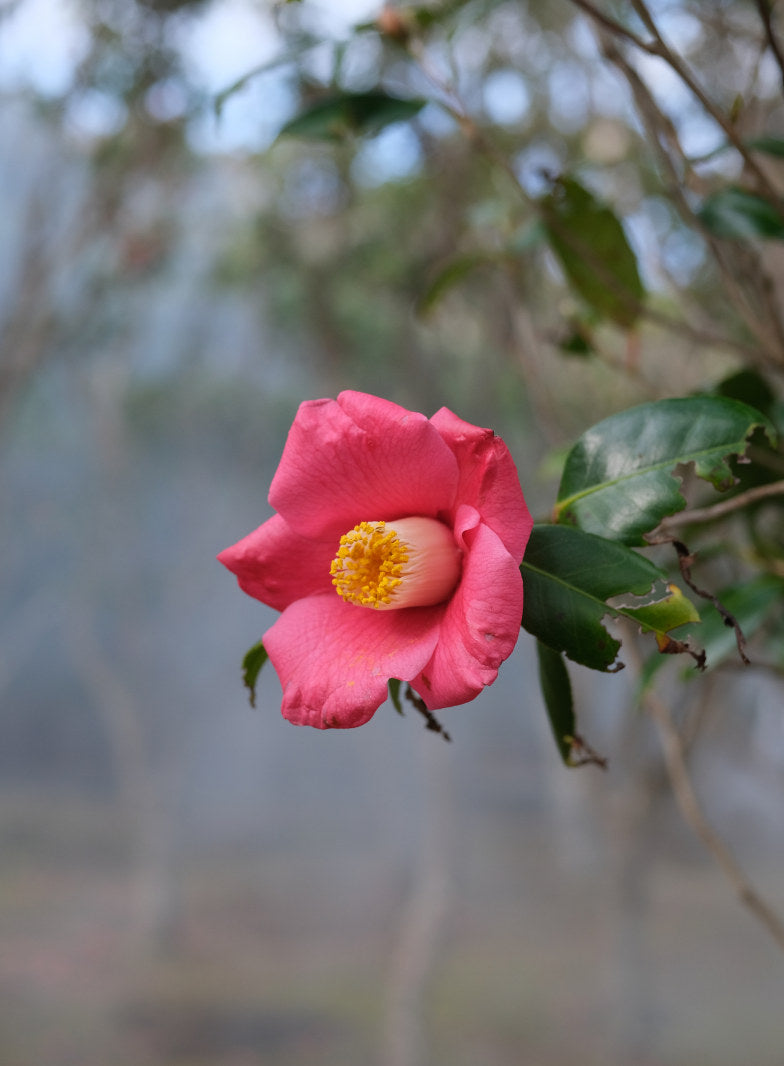
The common camellia, which blossoms in the still-chilly season, is a quintessential camellia variety.
It adds a lustrous glow.
As spring arrives, the camellia blossoms. Its stunning appearance has captivated people since the Manyo era. Kimonos, paintings, pottery, folk crafts... Everywhere you look, there are countless items that reflect the beauty of this flower. Meanwhile, we have used the oil extracted from its fruit for our daily hair and skin care.
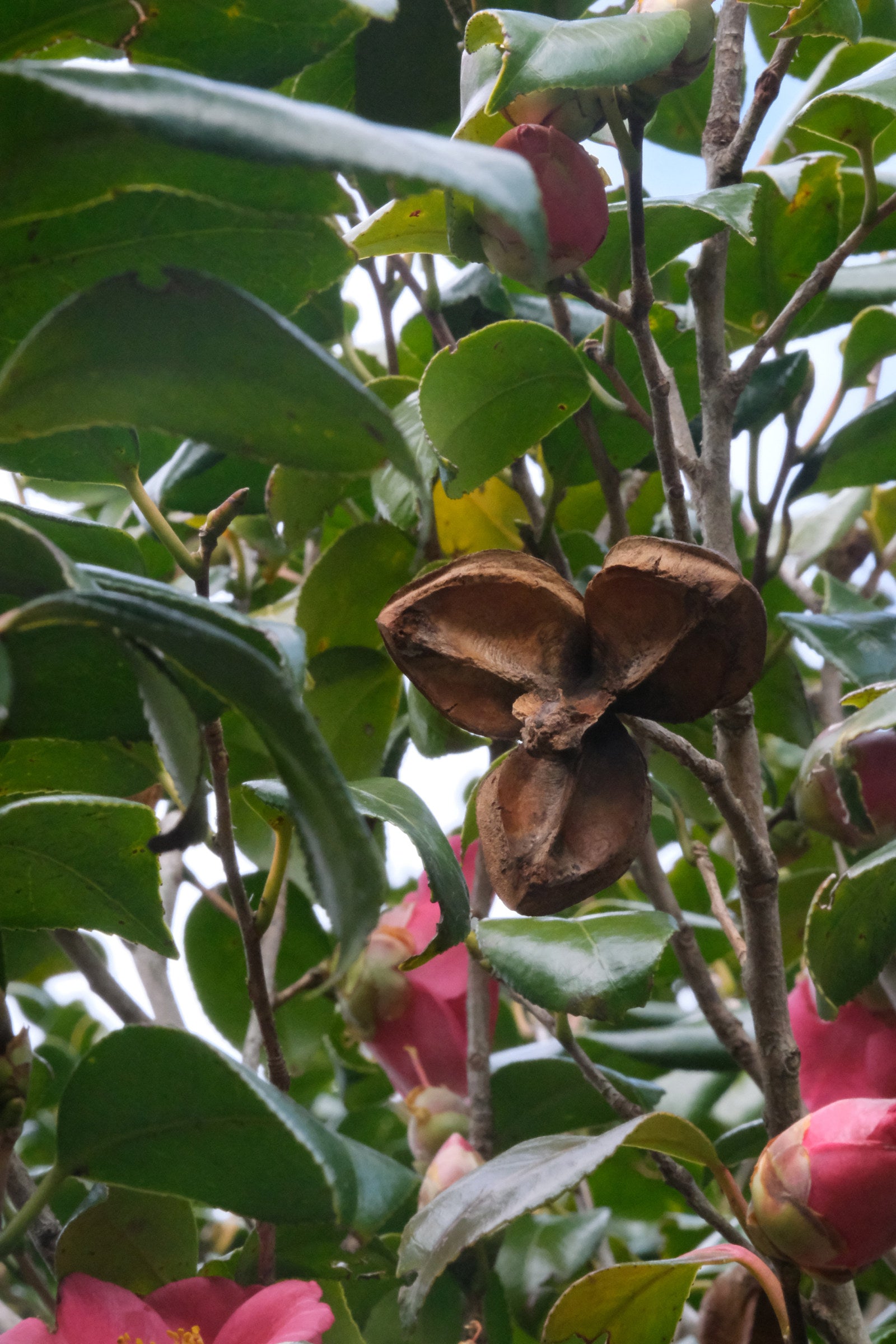
After flowering from March to May, the fruit ripens between October and November. The oil contained in the seeds is applied to the skin and hair.
Camellia oil absorbs smoothly, leaving a silky feel. Rich in oleic acid, which makes up our sebum, it moisturizes the skin and leaves it soft.
Sebum acts like a "barrier" protecting the skin from dryness and external irritants. Camellia oil supports this function, keeping the skin moisturized. Another feature is its resistance to oxidation, making it easy to maintain stable quality.
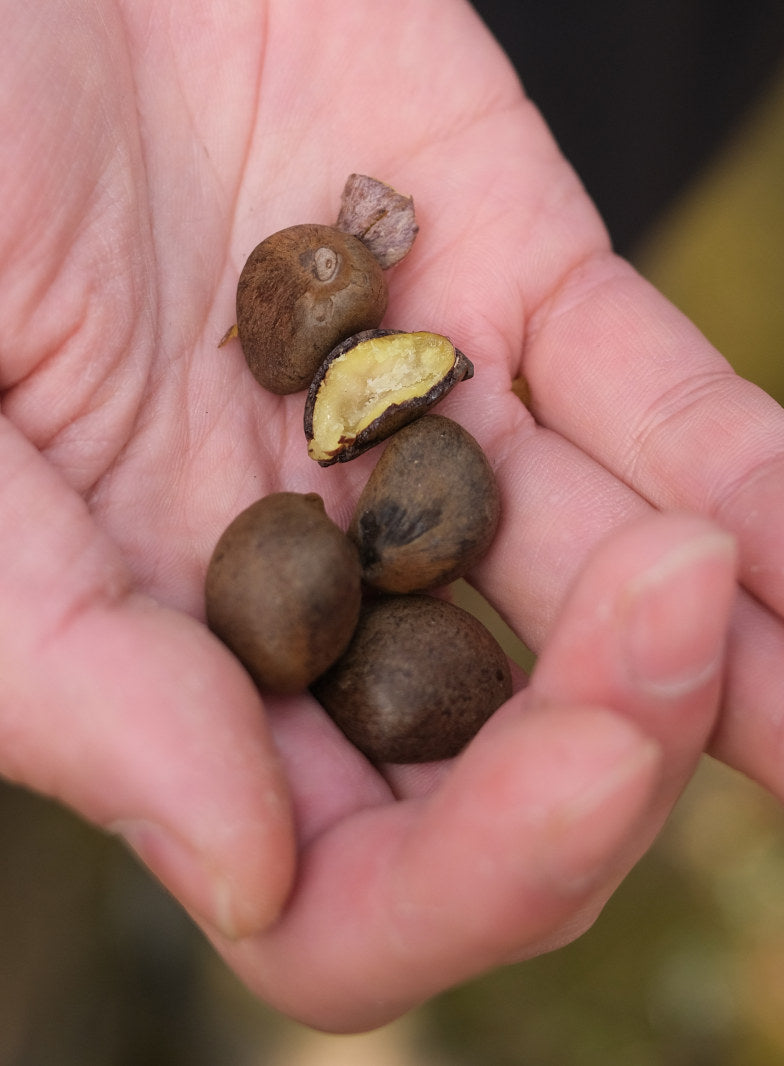
Only a tiny amount of oil can be extracted from the seeds, which are covered by a thick skin. Furthermore, it takes 25 to 30 years for a camellia tree to bear fruit. Camellia oil is born from an unimaginably long passage of time.
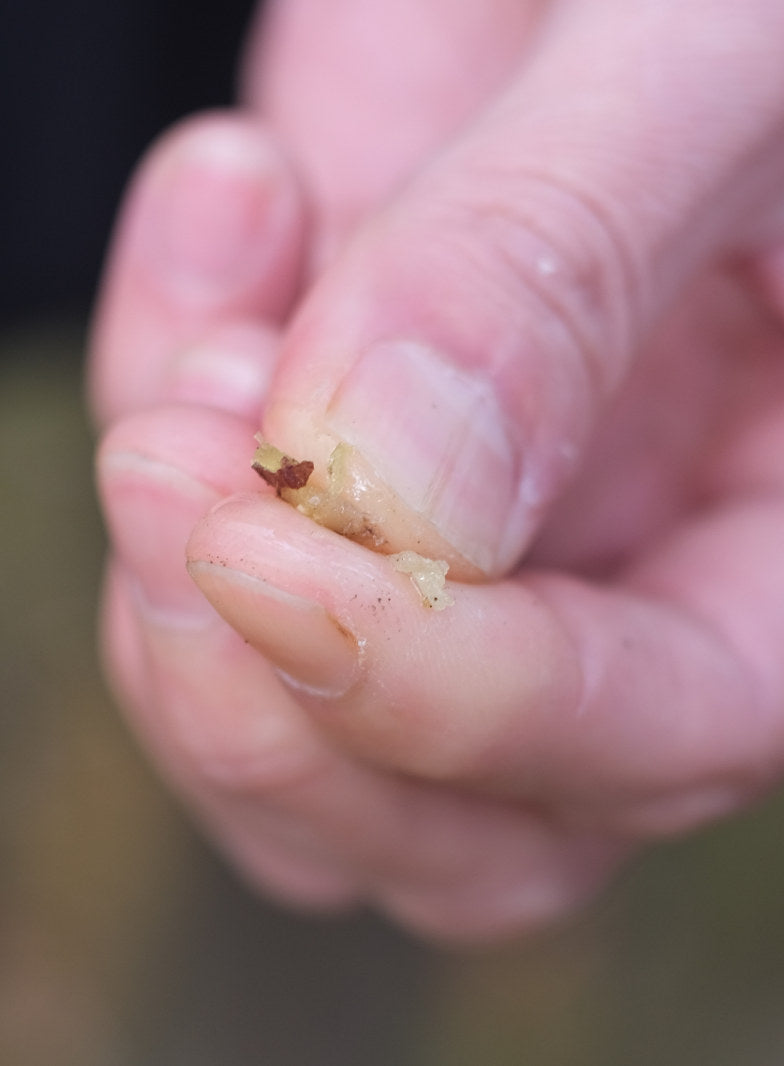
To Toshima, home of organic camellia oil.
Board a ship from Takeshiba Pier in Tokyo and head approximately 132.7 km south. It's about the same distance from the city center as Shizuoka or Nagano, but as soon as you embark on the sea journey, you're enveloped in a sense of grand adventure. As you sail across the vast ocean, a conical island quietly emerges.
Toshima Village, Tokyo—Despite being the second closest island in the Izu island chain, it has no breakwater, so when the sea is rough, ferries may not be able to dock. As a result, it carries an air of being a hidden, remote place.
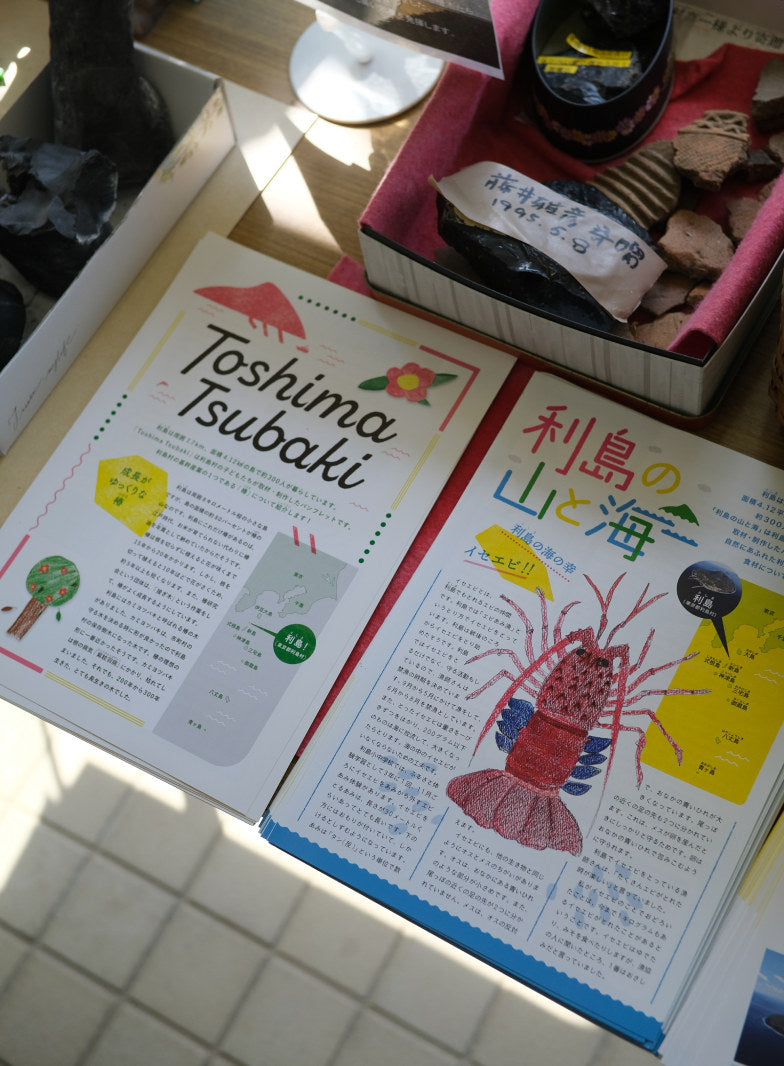
Approximately 300 people live on this compact island, which has an area of 4.02 sq km and a circumference of 7.7 km, and it is also known as one of Japan's leading producers of camellia oil.
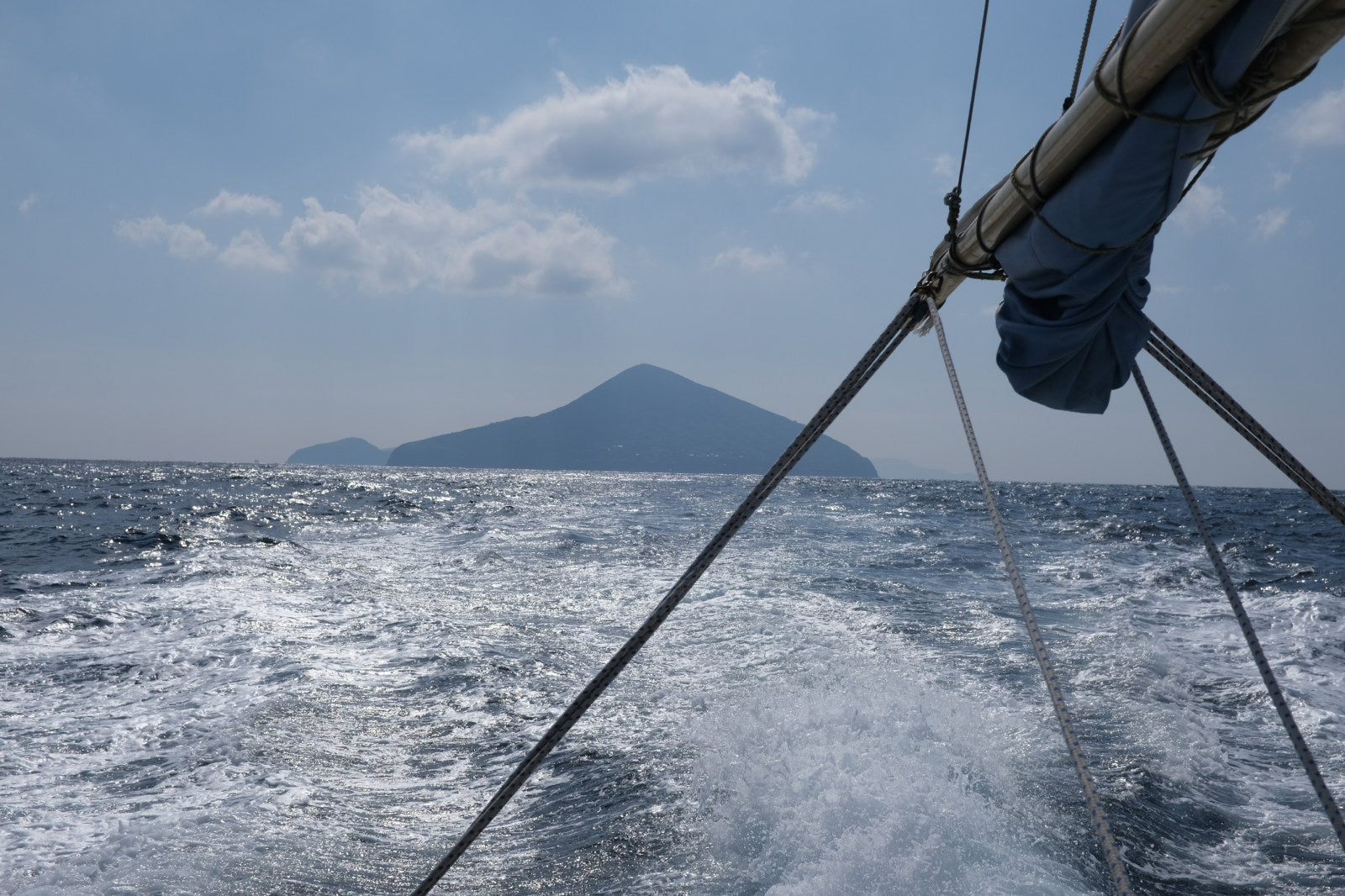
Toshima, an island whose very symbol, Mount Miyatsuka, is an island itself. It also serves as a landmark for sailors.
Each time I walk through the island, permeated with the scent of the tide mixed with plants, I am reminded that this land has always existed in harmony with nature.
Why did camellia oil production become so deeply rooted on such a small island? Its origins can be traced back to the Edo period. With no flat land, and no springs or rivers, it was impossible to cultivate rice, which was used for annual tribute. Therefore, people planted wild camellias, which could grow even with just rainwater, and paid tribute with the oil extracted from their seeds. In the camellia fields, water jars, called "shide," made from bamboo grass branches to collect raindrops, can still be found. From the traces of life carved into the village, we can sense the long history that the camellia industry has woven.
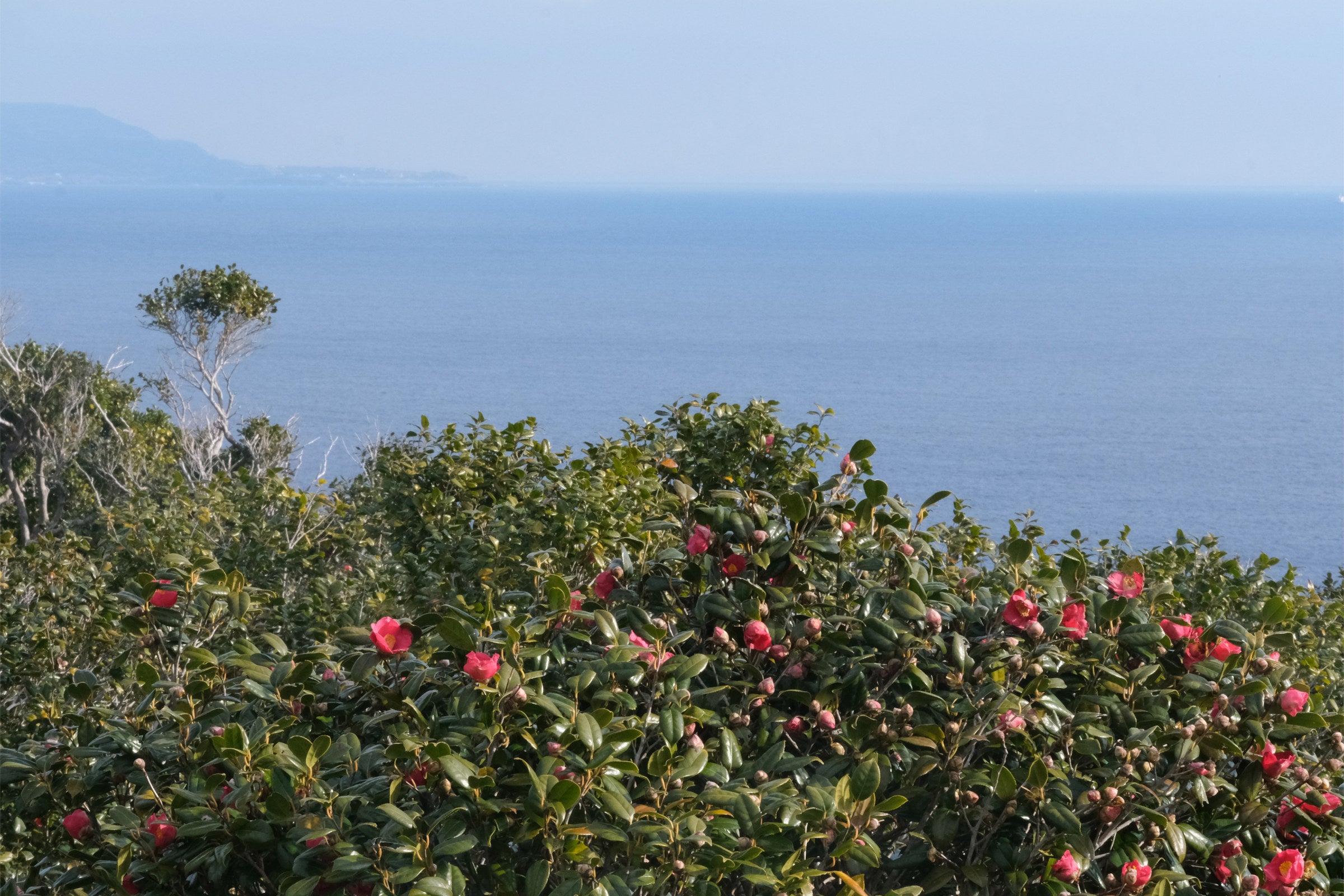
At the foot of Mount Miyatsuka, which soars in the center of the island, approximately 200,000 camellia trees are still planted today. As 80% of the region is camellia groves, the entire island turns crimson during the flowering season from January to March.
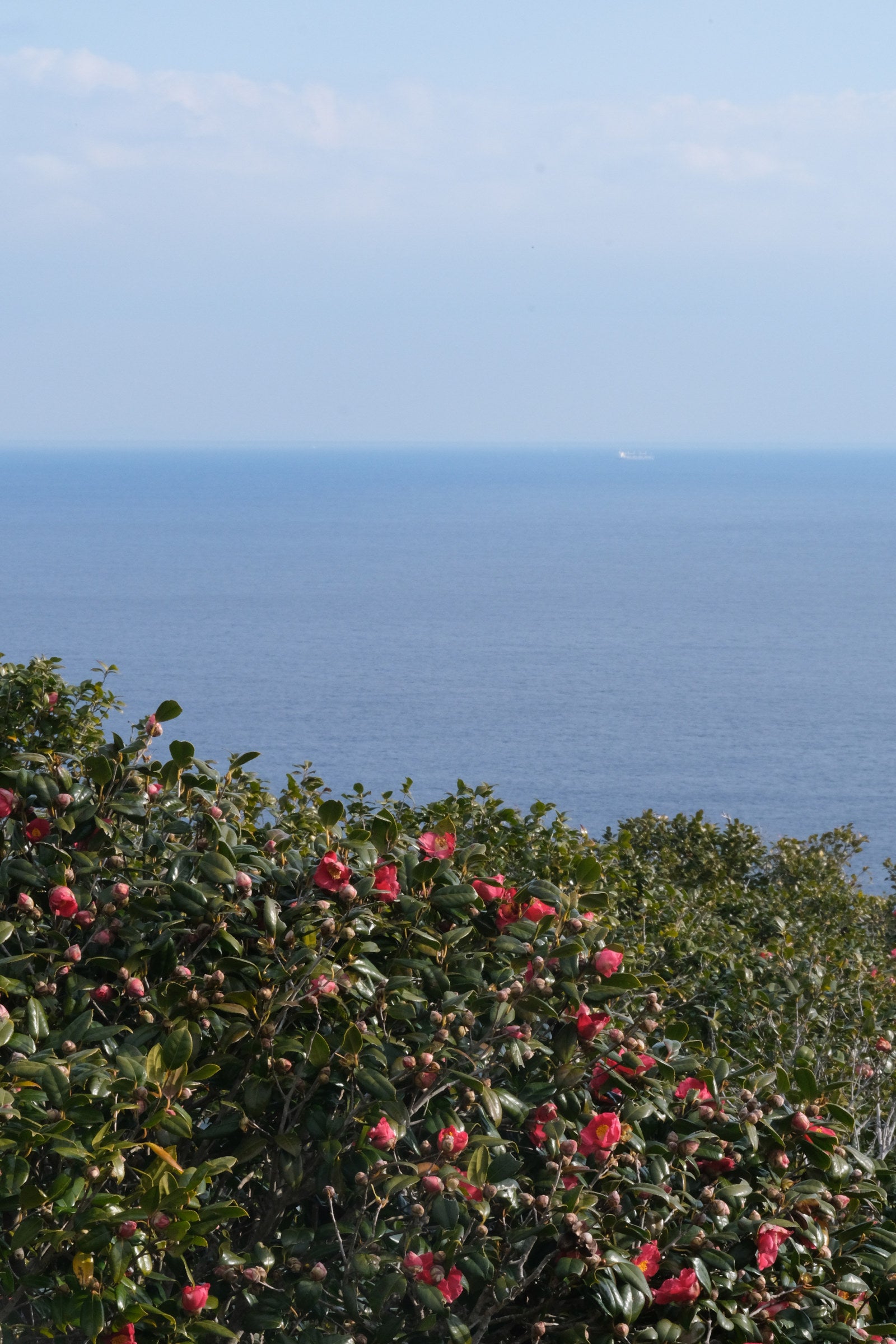
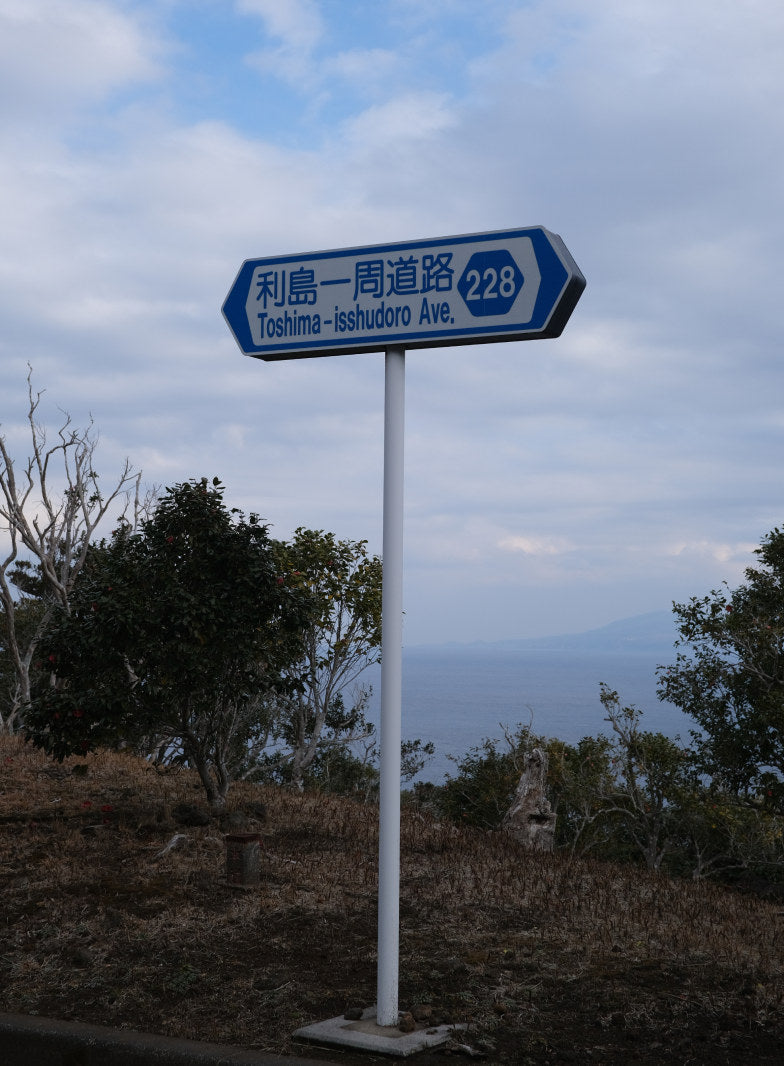
Beyond the camellia fields lies a magnificent view. On some days, you can even see Mt. Fuji in the distance across the horizon.
Stepping into fields dyed crimson by camellia flowers, I was greeted by a chorus of birdsong. Bush warblers, Japanese white-eyes, and brown-eared bulbuls carried pollen as they sipped nectar from the camellias, helping them to bear fruit. Apparently, the strongest wild animal on Toshima is the pheasant! A gentle ecosystem thrives here.
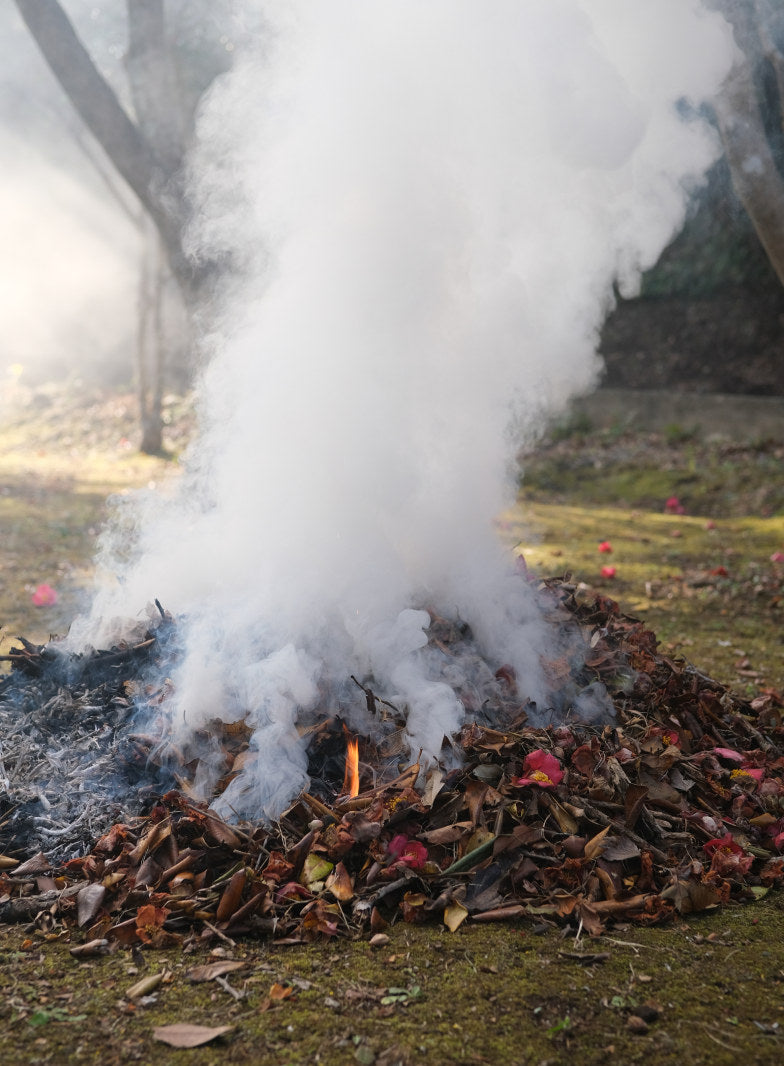
Looking at the ground, brown fruits peeked out from between pale pink petals. Farmers collect each fallen fruit by hand only after it has ripened and dropped naturally. Waiting for the fruit to burst before harvesting is a unique Toshima method. The season of fruit-bearing flows in harmony with the rhythm of the trees.
Harvest season lasts approximately five months, from October to March. During the peak in December, one person can reportedly collect about 20 kg of seeds in a single day. Anyone can pick up fallen fruits on the roads, and the agricultural cooperative buys the collected seeds.
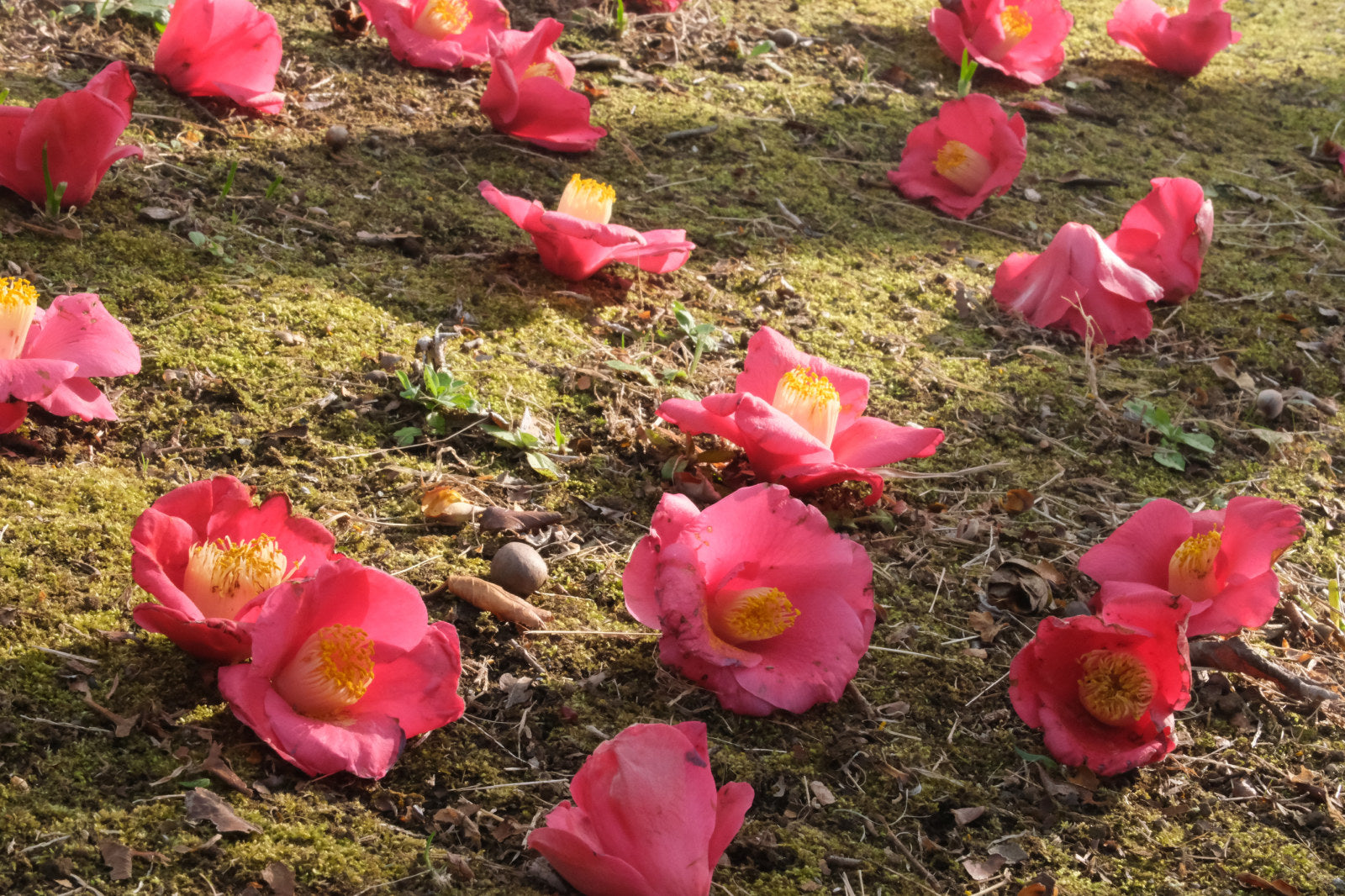
Once the blossoms have reached their peak on the branches, they scatter to the ground as whole flowers.
In Toshima, while the men went out to sea for fishing, the women took on the role of producing camellia oil. This tradition continues unchanged even after more than three centuries, as they manage the camellia forests. It is thanks to these women that Toshima's camellia oil culture has been passed down through generations.
Furthermore, the fences surrounding the fields were made using rounded beach stones. It was also the women who carried these stones up steep slopes and cleared the land. From the landscapes remaining all over the island, the image of these resilient women comes to mind.
Beyond the strength of the producers, the camellia itself also possesses great vitality. It deeply roots itself in arid land and keeps its leaves green all year round. Although its growth is slow, it is said to bear abundant fruit until it is about 40 years old. It is precisely because of this resilience that it can be cultivated without relying on pesticides. Additionally, due to the sloped terrain, herbicides are not used either.
Recognizing this cultivation background, in 2019, the raw material obtained the global organic certification "COSMOS ORGANIC."
Until Camellia Oil is Made
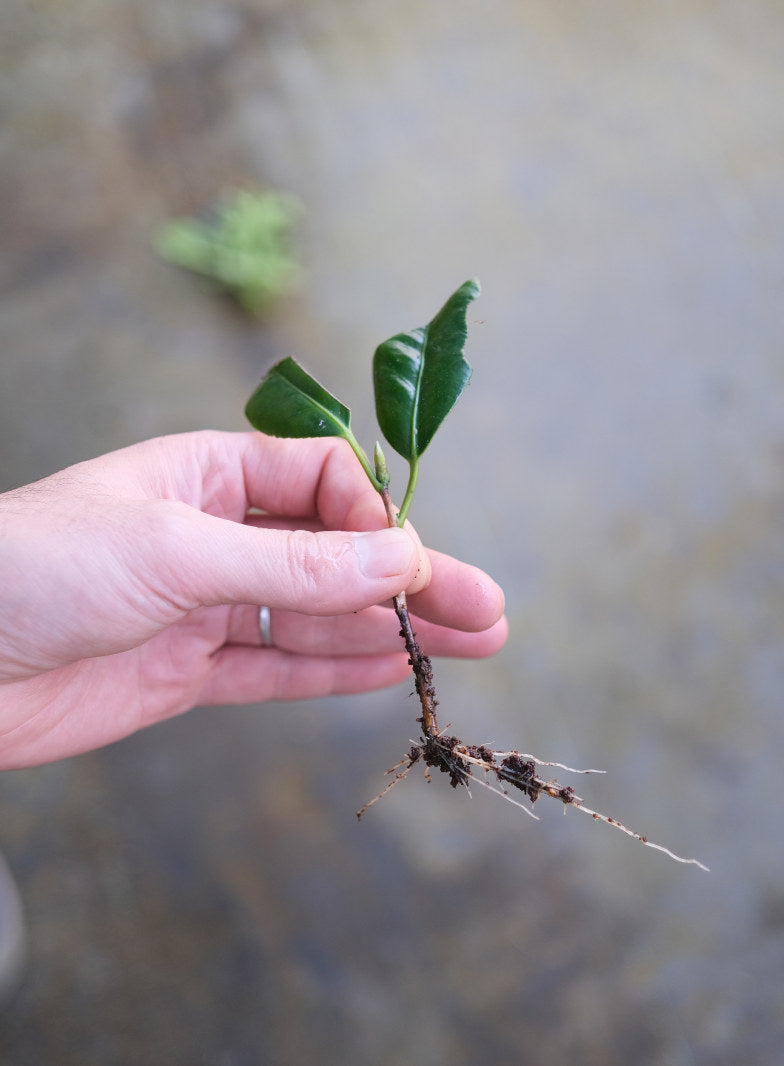
Camellias slowly but steadily grow their shoots. Meanwhile, Toshima faces challenges such as the aging of farmers and a decrease in the number of people involved in cultivation and production volume. To pass on camellia oil production, which has continued since the Edo period, to the future, the agricultural cooperative is cultivating seedlings. By creating an environment where producers can easily continue cultivation, they are supporting the island's industry.
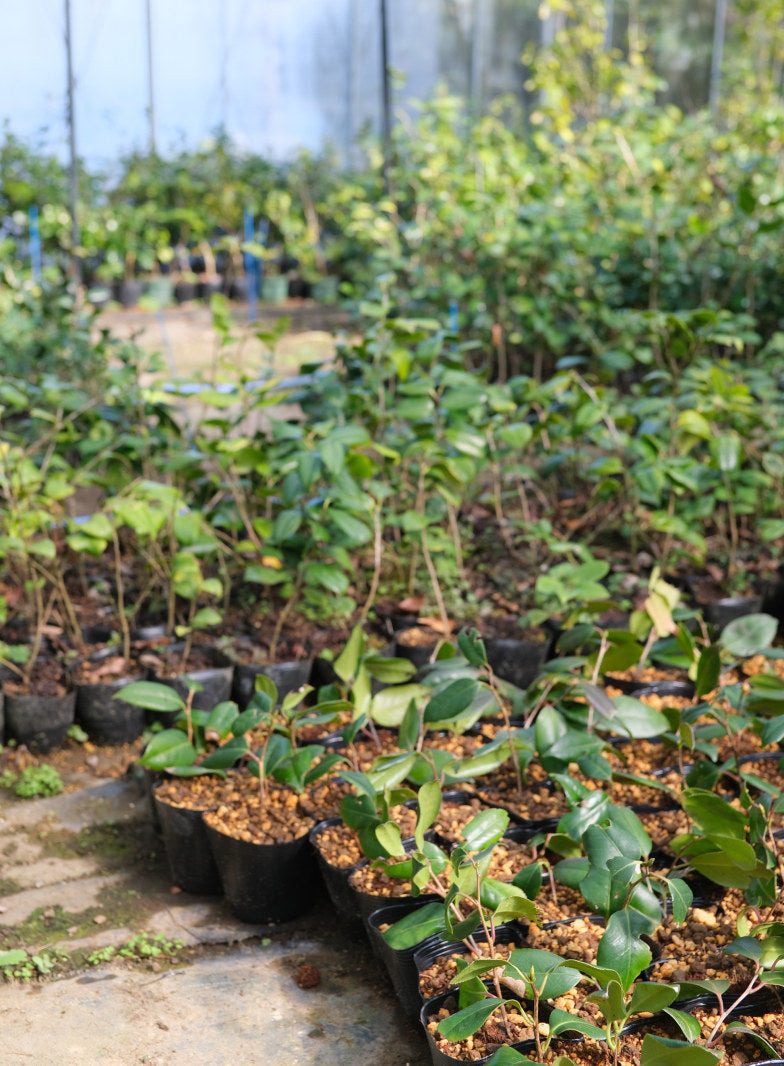
Visiting a greenhouse in a corner of the village, you'll find rows of seedlings from their first to fifth year. The seedlings, grown sturdily in the optimal environment for camellias, are transplanted to fields in their sixth year.
After many more years, they finally bear flowers and fruit.
Stepping into the factory, I was enveloped by a savory aroma, like roasted nuts. In Toshima, the agricultural cooperative has been responsible for producing camellia oil since 1979. Before the oil mill was established, producers extracted the oil themselves, which reportedly led to inconsistencies in quality. By entrusting the JA with the entire processing operation, farmers could focus on cultivation, and the quality of the finished camellia oil became stable.
My gaze shifted to the entrance, where white and blue bags were piled high, leaving little room. Inside, they were packed with harvested seeds. Farmers bring these 20kg bags in units of 400kg. Some reportedly deliver as much as 4 tons of seeds. These piles of bags are the crystallization of their careful cultivation and daily, diligent harvesting.
From these delivered seeds, camellia oil for cosmetics and food is born.
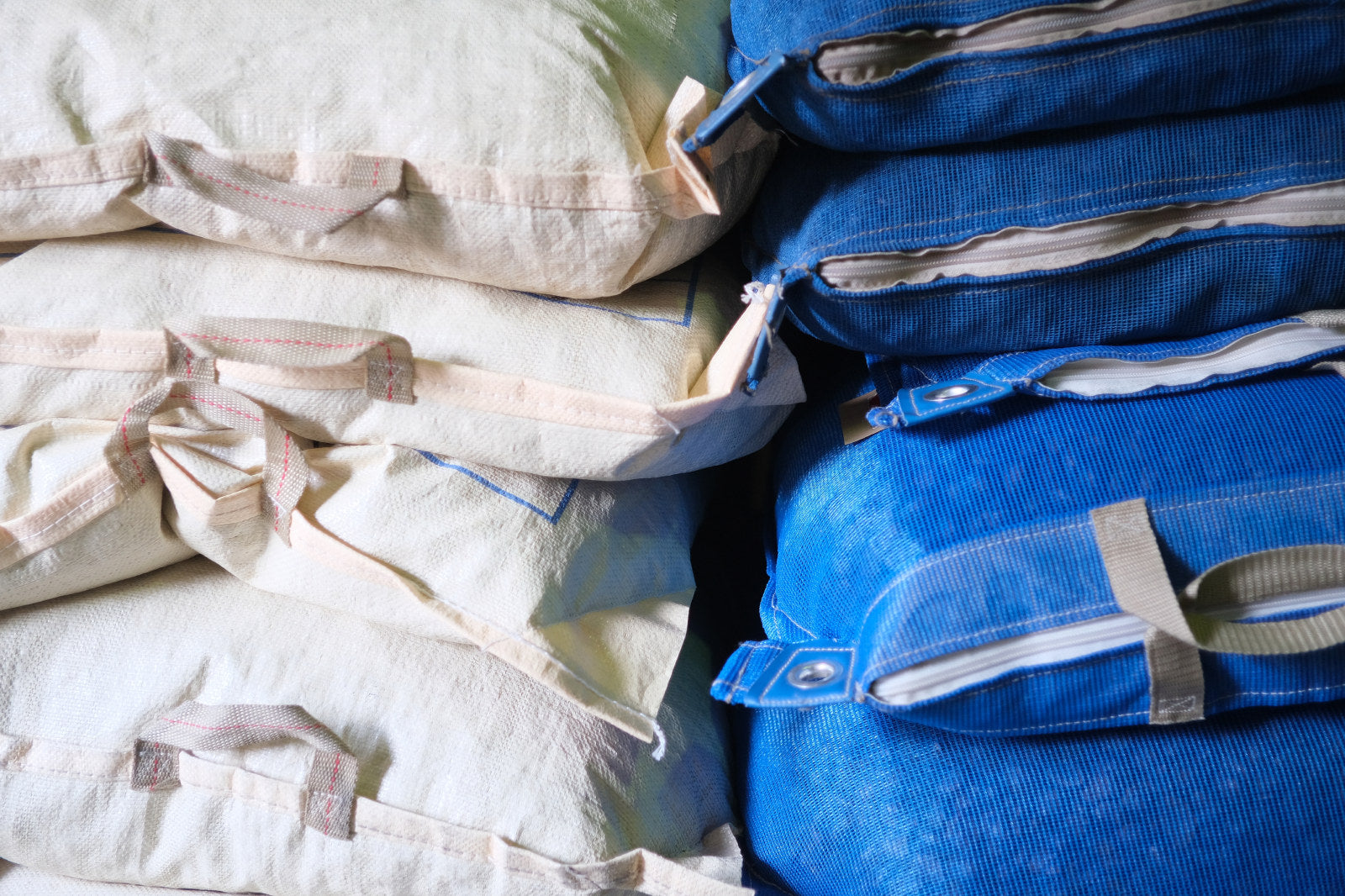
The producer's brand name is printed on the bag. The white bags, by the way, are COSMOS ORGANIC certified.
At JA Toshima, each producer handles the entire process up to oil extraction. This is to ensure that we can trace who cultivated the olives, which fruits the oil came from, which field they grew in, and whose hands harvested them. The names written on the bags are proof of this.
Oil production begins with "pretreatment" to remove fallen leaves and small stones mixed with the seeds. Only ripe fruits are sorted using a specialized machine. From there, they are dried in the factory for about 8 hours.
Then comes the main process of pressing the fruits, where the seeds are transformed into oil.
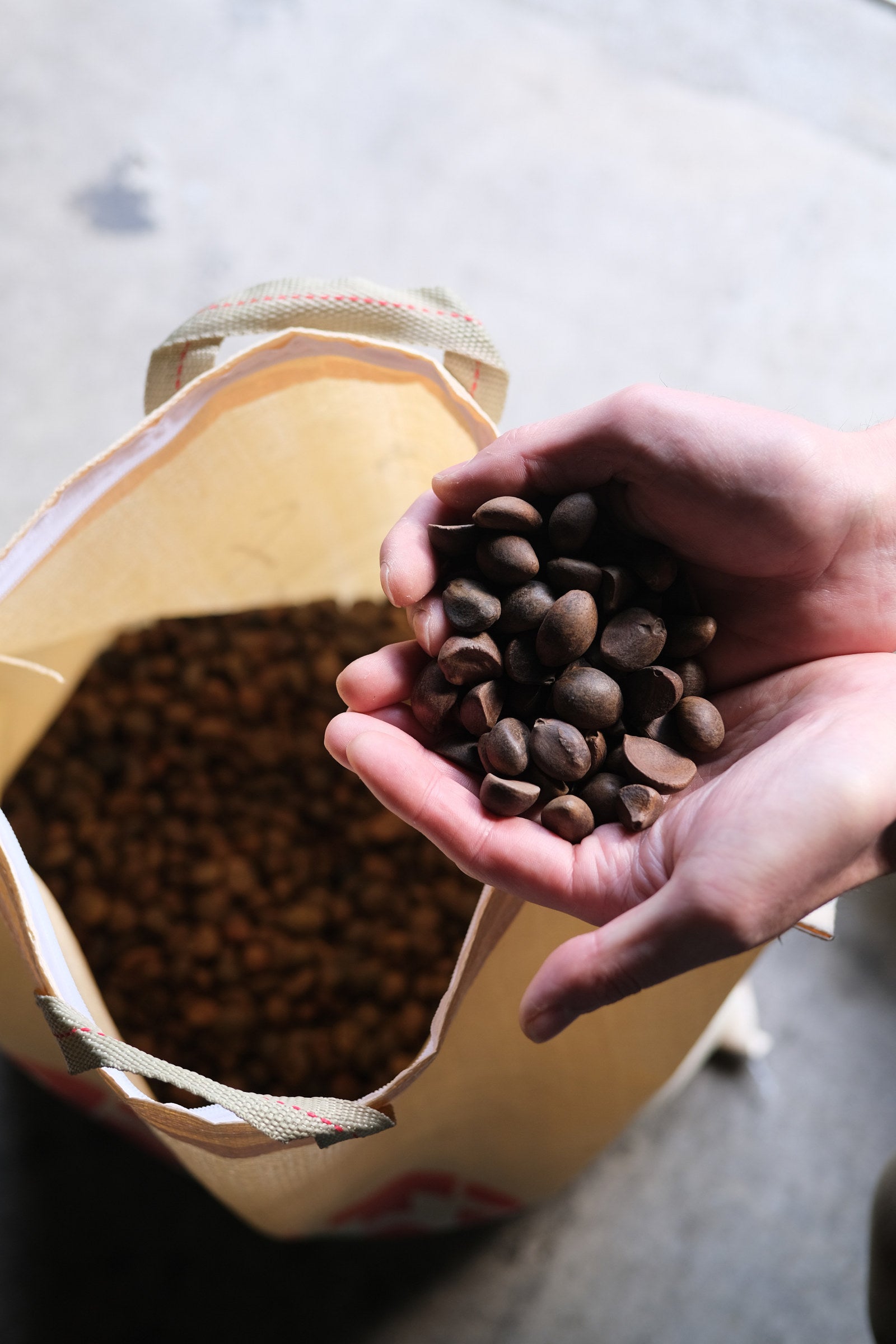
Opening the bag revealed a generous amount of glossy fruit!
The day after "drying" is the real thing! The seeds, now rid of excess moisture, are heated to 50-60 degrees Celsius, the optimal temperature for oil extraction, and then slowly pressed.
From the oil press, golden oil flows thickly. The first-pressed oil that drips out is transferred to a measuring tank, where the producer's name and the amount of oil extracted are recorded. The farmers are then compensated on the spot according to the amount of oil extracted.
The oil pressing, which takes place twice a year in April and October, is said to handle approximately 800 kg of seeds per day.
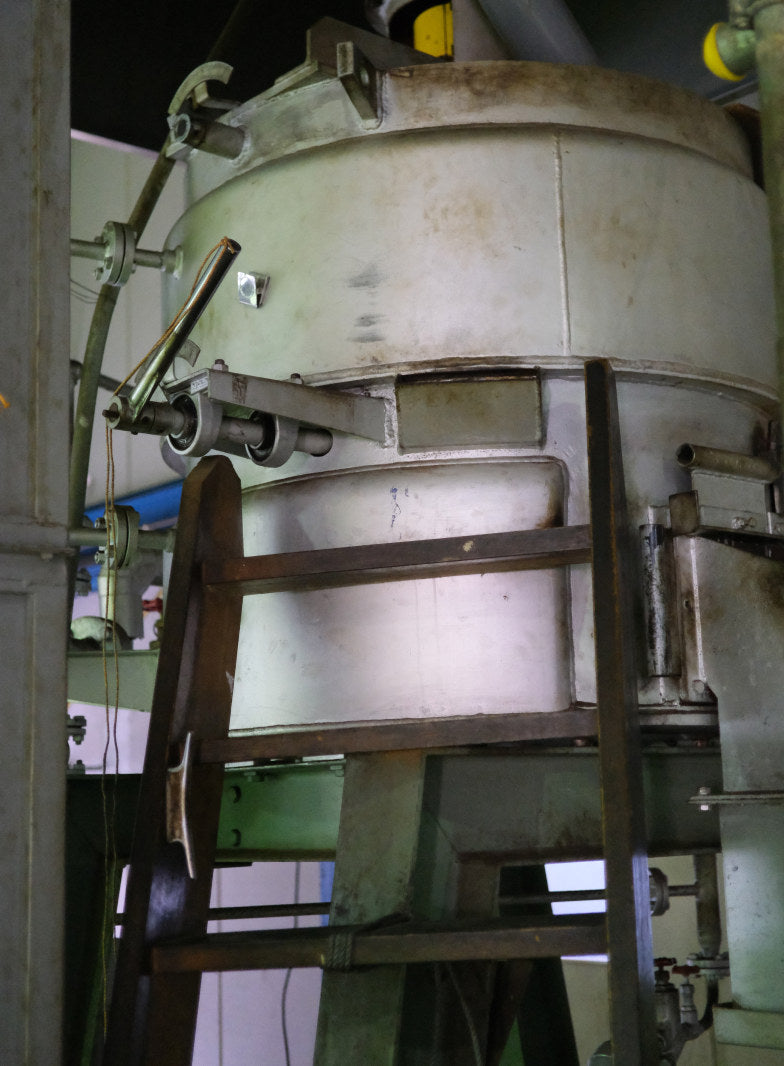
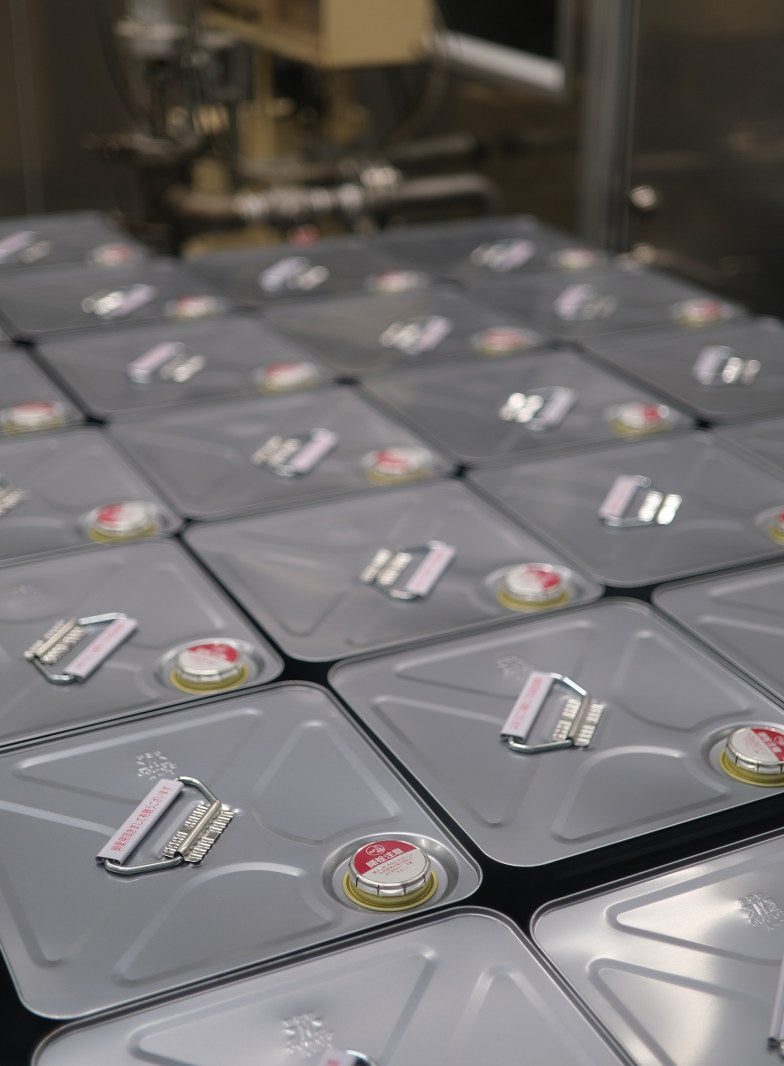
The process of making camellia oil isn't over yet. After blending the crude oil extracted by each producer, it undergoes centrifugation to remove phospholipids. Furthermore, the traditional "Yu-Tataki" method, which involves adding 50-60 degree hot water and stirring, is performed to carefully remove impurities. Through repeated "refining" and "filtering," combining modern technology with tradition, Toshima's camellia oil is finally completed.
This product is made from fruits that have been nurtured by abundant sunlight. Each drop, born from meticulous effort, contains high purity and rich ingredients that support moisture.
At Obi, we have incorporated this Toshima camellia oil into all of our products.
Text: Mako Matsuoka / Photographs: Kana Sato